Aviator Predictor: Can You Predict the Aviator Multiplier?
Aviator Predictor: Can You Predict the Aviator Coefficient?
There's a whole industry of "predictors" that has long existed around Aviator. You can find apps, Telegram bots, and websites that promise to show you the next coefficient before the plane flies away. Some supposedly analyze round history, others refer to artificial intelligence, and still others promise almost a direct connection to the game server.
It sounds tempting. Especially when screenshots are shown alongside: the program wrote 8.20x, and a few seconds later, Aviator indeed reached approximately that value.
But here, it's worth asking a more useful question: what data can such a predictor even obtain to know the result of the next round?
We looked at how the original Aviator by SPRIBE is structured, what is known about its Provably Fair mechanism, and what exactly an analysis of previous coefficients can yield. In short: we found no basis to consider ordinary public Aviator Predictors, bots, and "signals" as a way to find out the next coefficient.
First, let's understand how Aviator works
Aviator is a crash game by SPRIBE, released in 2019. There are no reels and winning lines here, like in a classic slot.
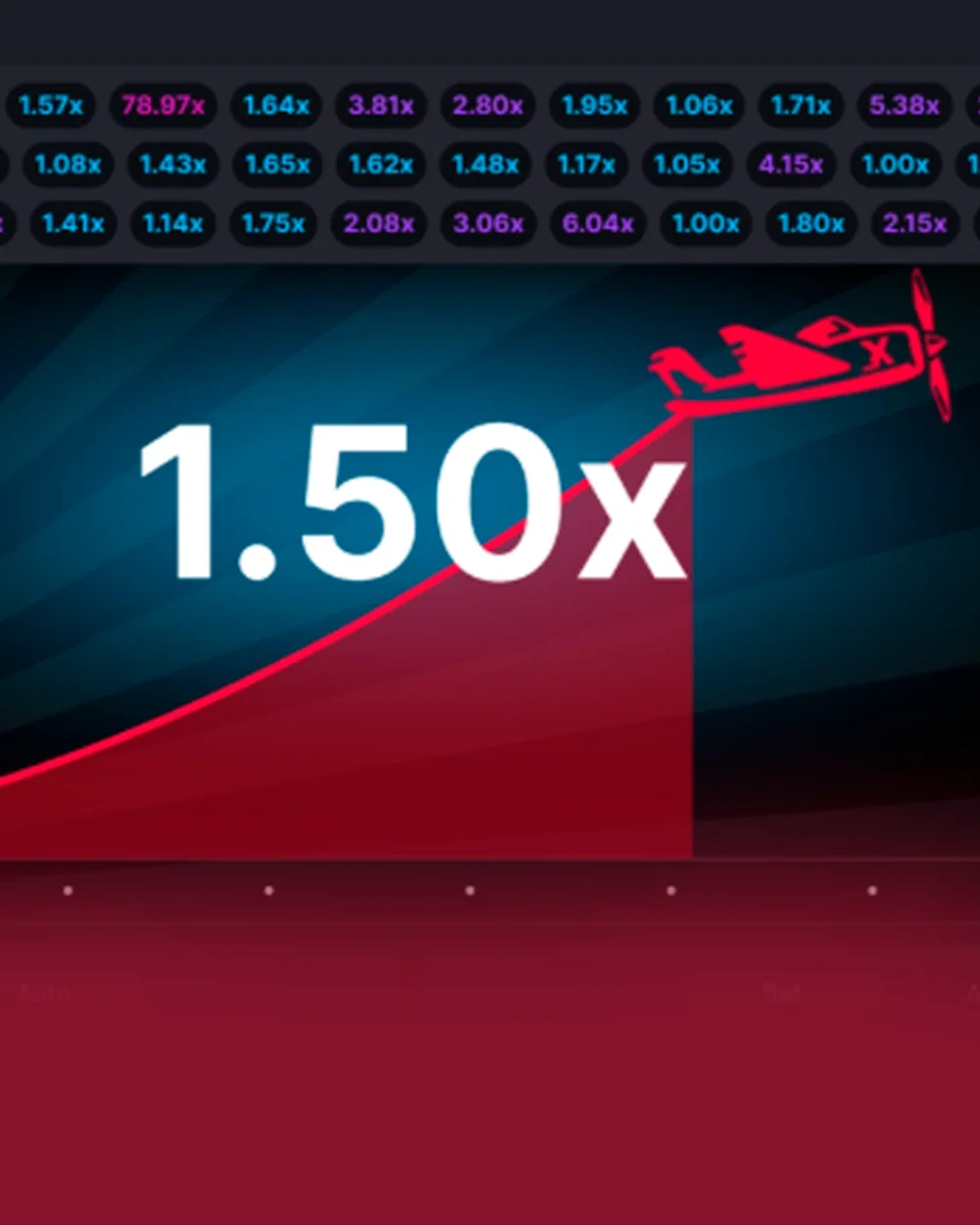
A round starts with a coefficient of about 1x. Then the coefficient grows until the plane flies away. The player must manage to cash out their bet before that.
Bet $10 and cashed out at 1.50x — you get $15, including the initial bet. Waited for 3x — $30. If the round ended before Cash Out, the bet is lost.
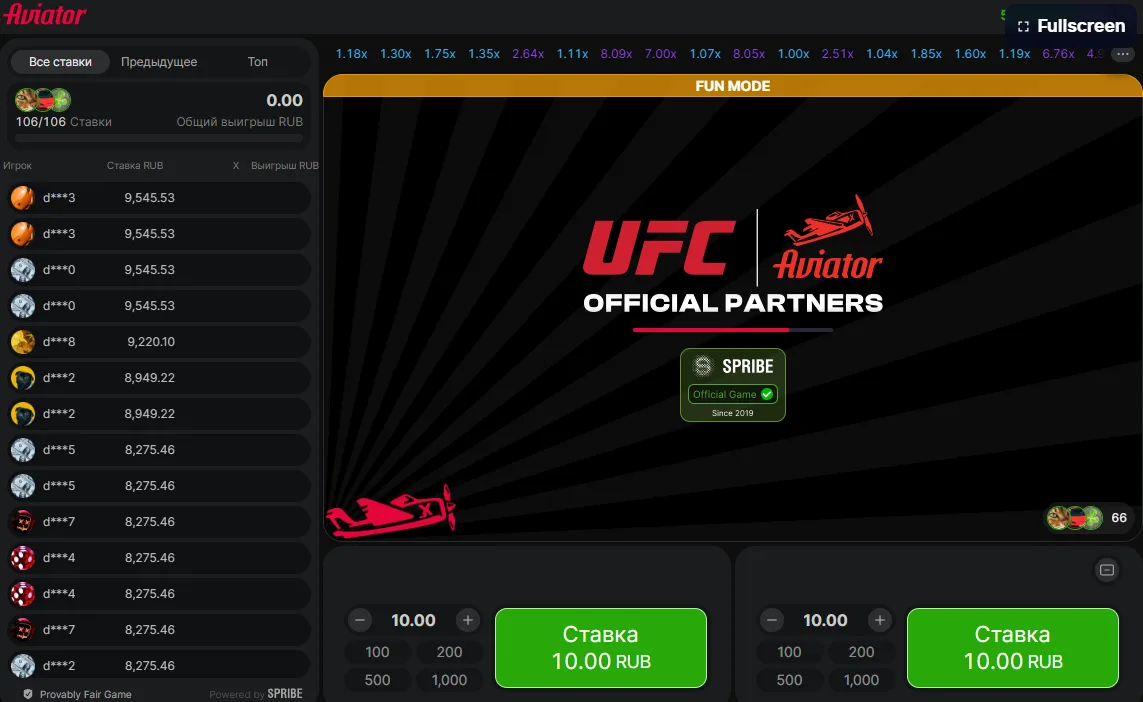
The mechanic itself is easier to see once than to describe at length. For this, we have a free Aviator demo version.
According to SPRIBE and operators offering the original game, the theoretical RTP of Aviator is 97%. On Stake, the game also lists an RTP of 97% and a house edge of 3%.
These are important figures, but they don't mean that after every $100 wagered, the player will necessarily get $97 back. RTP works over a long distance. The result of an individual gaming session can differ significantly from the theoretical value.
What does Aviator Predictor do then?
This is where it gets interesting.
Completely different things are sold under the name Aviator Predictor. This could be an APK for Android, a Telegram bot, a website with a timer, or a program that shows something like:
Next round: 5.73x
Sometimes, "Accuracy 98%" or a mention of AI is also present.
The interface itself proves nothing. Drawing a Predict button and displaying a random number from 1 to 100 is technically not difficult.
For a real predictor to work, it needs a way to obtain information related to the yet unknown result of the next round.
This is precisely where the idea runs into problems.
Why past coefficients don't allow you to know the next one
Imagine this sequence:
1.04x → 1.17x → 1.31x → 1.08x → 1.22x
After several low results, it's easy to think that a large coefficient should appear now.
This is a familiar cognitive bias when dealing with random events. We instinctively look for balance even where the previous result doesn't create an obligation for the next one.
Five small coefficients in a row do not imply that the sixth must be 10x.
Similarly, after 50x, there's no rule that the next round must end at 1.10x.
The history of Aviator can indeed be collected and analyzed. You can take 10,000 or a million rounds, build a distribution of coefficients, and look at frequencies and series.
This will be a statistical analysis.
But answering the question "how often did X happen?" is not the same as answering "what will the coefficient be in a minute?"
What if the Predictor uses AI?
The word AI doesn't solve this problem.
A machine learning model can indeed find complex dependencies in large datasets. But for a prediction, the input data must contain information related to the event being predicted.
If the program is only given history:
2.31x, 1.02x, 7.48x, 1.51x, 3.17x...
it can analyze this sequence as much as it wants.
This does not reveal the secret value of the next round.
You can create a beautiful neural network, name it Aviator AI Predictor 2026, and train it on a million past results. It still needs to get information about the future round from somewhere to consistently predict it.
Therefore, the statement "our predictor uses AI" in itself proves nothing.
Provably Fair — that's what's really important
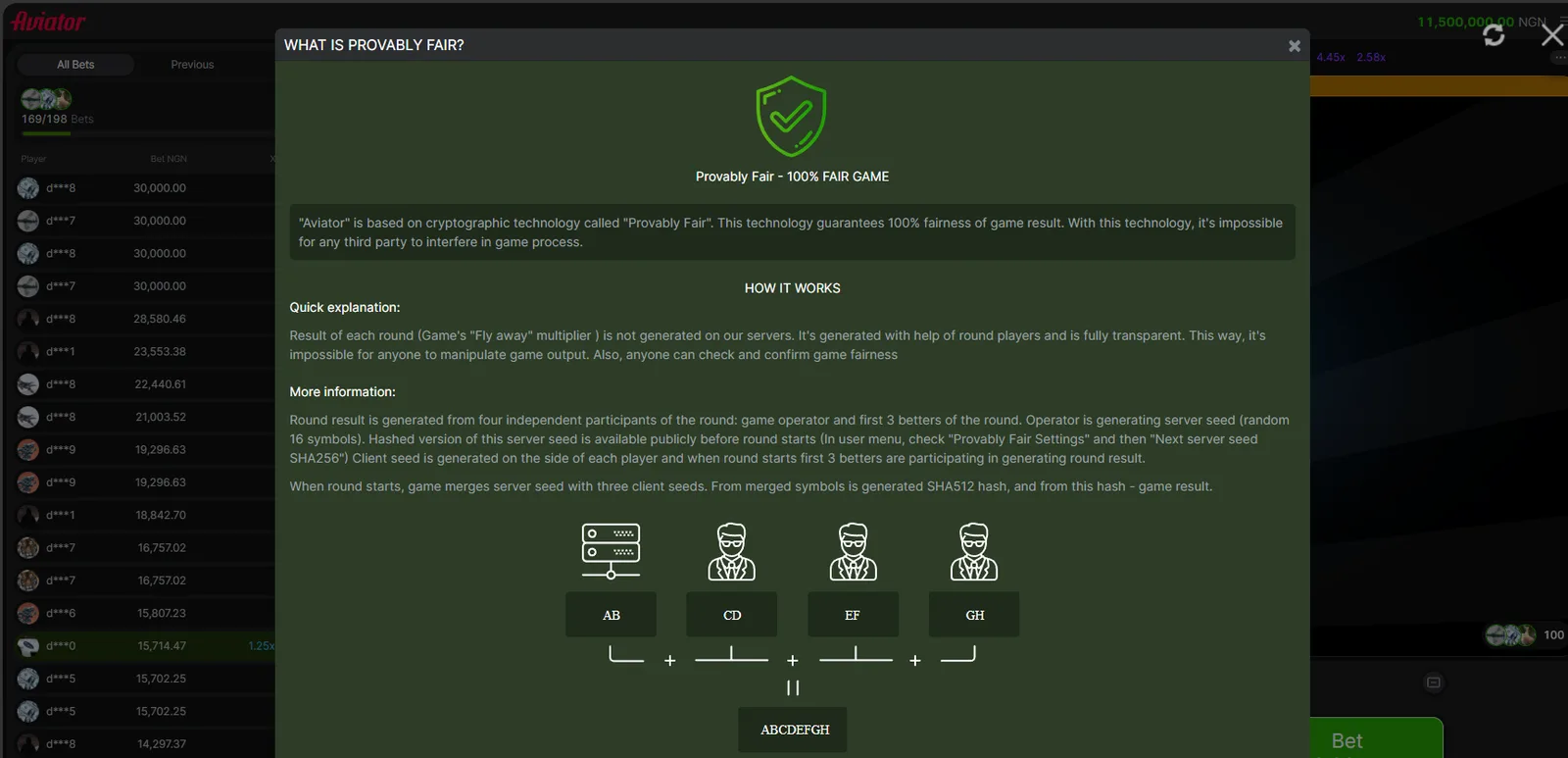
The original Aviator uses Provably Fair.
This is not a marketing name for a predictor, but a mechanism that allows verifying the fairness of game results using cryptography.
The Aviator rules explicitly provide for the ability to check the fairness of a specific round through the game's Provably Fair settings. The available game documentation also states a theoretical RTP of 97%.
The purpose of Provably Fair in this case is not to show the player the future coefficient. On the contrary, the system is designed so that the result can be verified, not used in advance for a guaranteed bet.
This is a fundamental difference.
Verify result ≠ know result in advance.
That's why the phrase "our bot decrypts Provably Fair" requires very serious proof.
Can you calculate the next coefficient from the hash?
This is often where the pseudo-technical part of predictor advertising begins.
The user is shown a long string of letters and numbers, SHA-256 or SHA-512 is written next to it, and the conclusion is drawn that the program supposedly "decrypts the hash."
Cryptographic hash functions are not like ordinary encryption with a "decrypt" button.
A hash allows you to get a fixed result from the input data, but a normal cryptographic hash function is specifically designed so that the original data cannot be practically recovered by simple inverse calculation from a single hash.
Therefore, the presence of a hash does not mean the future coefficient is available in plain text.
This is roughly like having a fingerprint and claiming that you can reconstruct a person atom by atom from it.
Then where do the videos where the Predictor guesses come from?
The mere fact of a match proves nothing unusual.
Suppose a program makes 20 predictions. Five turned out to be spectacular, the other fifteen — not.
If you show the viewer only five successful attempts, you get a video with an almost perfect predictor.
There's an even simpler problem: screen recordings can be edited after the result is known.
Therefore, demonstrating a few matching coefficients is very weak evidence.
It would be much more interesting to see pre-published results of at least several hundred consecutive rounds that cannot be changed after publication.
Now that could be analyzed statistically.
How to properly test any Aviator Predictor
There's no need to buy an app, and certainly no need to immediately bet money based on its signals.
The test should be boring. That's why it's useful.
Let's take, for example, 500 consecutive rounds. Before each round, the Predictor must record a specific forecast. After that, we record the actual result.
You cannot delete failed attempts. You cannot change the range after the round. You cannot consider a phrase like "in the next five rounds, we expect a large coefficient" as a forecast.
At the end, two columns should remain:
| Forecast | Actual Result |
|---|---|
| 2.40x | 1.13x |
| 1.70x | 3.21x |
| 5.20x | 1.04x |
| ... | ... |
After several hundred observations, you can already check if the program has a statistically significant advantage over a simple random forecast.
Surprisingly, advertising pages with "98% accuracy" usually don't rush to publish precisely such a test.
Telegram signals — the same problem
Signals look a little more plausible because there's a real person behind them.
For example:
Aviator Signal: Cash Out 2.10x
If the coefficient reaches 2.10x, the message looks like a successful prediction.
But the source of information still remains unknown.
If the author analyzes previous coefficients, we return to the round history again. If a "secret algorithm" is used, its effectiveness needs to be tested on a large, pre-recorded sample.
The phrase "we have a 93% success rate for the week" without a complete history of all signals is almost useless.
Do Aviator strategies work?
It's important not to confuse betting strategy with predicting the outcome here.
You can choose different Cash Out points.
One player consistently cashes out at 1.30x. Another waits for 2x. A third tries to catch 10x.
These approaches will have different frequencies of successful Cash Outs and completely different bankroll behavior. But choosing the exit point does not reveal the next crash point.
The same applies to Martingale:
$1 → $2 → $4 → $8 → $16 → $32
After a loss, the bet is increased in the hope of covering previous losses.
This does not create a mathematical advantage over the game. However, the bet size grows very quickly: after several consecutive losses, a completely different bankroll is required.
If you want to see how such systems behave over a long series of random results, you can use a slot simulator for experiments. It's more useful than a dozen screenshots with a "working strategy" because it allows you to look not at one beautiful result, but at the long run.
Aviator RTP — 97%. What does this mean in practice?
Aviator has a stated theoretical RTP of 97%.
Accordingly, the mathematical difference to 100% is 3%.
But you cannot take a $100 deposit and conclude:
"I'll lose a maximum of $3."
That's not how RTP works.
If a very large volume of bets passes through the game, the theoretical model tends towards its long-term value. An individual session can end with a large profit or a complete loss of the allocated bankroll.
For the same reason, a short successful Predictor series proves nothing. Random processes constantly create series that, in hindsight, look like a pattern.
Is Aviator available on Stake?
Yes. The original Aviator by SPRIBE is available on Stake. On the game page, the operator indicates an RTP of 97% and a house edge of 3%.
We discussed the platform itself in more detail in the Stake review.
Sometimes you might encounter specific queries like "Stake Aviator Predictor." The addition of a casino name does not create a fundamentally new type of predictor. If it's about the original SPRIBE game, you still need to prove how a third-party program obtains unknown data for the future round.
Among crypto casinos, we also have a separate Duel review. Before registering on any platform, it's worth checking its terms, availability in your country, and withdrawal rules.
Should I download Aviator Predictor APK?
I wouldn't install an unknown APK just for the promise of predicting the coefficient.
Especially if the app asks for:
- login or password for the casino;
- SMS access;
- installation from an unknown source;
- disabling Android protection;
- a deposit for "synchronization";
- payment for an activation key;
- seed or other account data.
At this point, the question is no longer whether the program guesses the plane or not. You are installing unknown software and granting it access to your device or account.
If you just want to see how Aviator works, it's safer to start with the demo version, where real bets are not needed to understand the game itself.
Can Aviator still be predicted?
We have not found reliable evidence of the existence of a public Aviator Predictor capable of consistently determining the coefficients of the original SPRIBE game in advance.
This is a more accurate phrasing than simply writing "all predictors are scams."
Theoretically, a completely different situation could be imagined: for example, a critical vulnerability in a specific game implementation or the compromise of secret data. But this is a matter of information security, not an analysis of coefficient history, an AI bot, or a $30 app.
For the average player, the practical conclusion is simpler.
The history of previous rounds shows the past. RTP describes the game's math over the long run. Provably Fair allows verifying results. None of these things by themselves tell you the next coefficient.
So when another Aviator Predictor promises:
"97–99% accuracy"
the correct first question is not "where to download?", but:
"Show 500 pre-recorded consecutive predictions."
If instead of data, they show a Lamborghini, a wad of cash, and a link to Telegram, the investigation can probably end.
Short answers
Does Aviator Predictor really work?
We have not found reliable evidence that public predictors, which determine the coefficient of the original Aviator in advance, actually work.
Can you find out the next Aviator coefficient?
Based on the history of previous coefficients — no. To determine a specific result in advance, information that an ordinary third-party predictor does not possess would be required.
Can AI predict Aviator?
AI itself — no. Machine learning can analyze past statistics, but for stable prediction of future results, it needs a corresponding informational signal.
Is there a pattern after several small coefficients?
A series of small results in itself does not mean that the next coefficient must be large.
What is Aviator's RTP?
For the original Aviator SPRIBE, a theoretical RTP of 97% is stated. Stake also indicates an RTP of 97% and a house edge of 3% for its Aviator page.
Can I try Aviator for free?
Yes. A demo version of Aviator is available on SlotSims, where you can see how the game works without betting real money.
Conclusion
The main problem with Aviator Predictor is not even how beautiful it looks. The problem is the source of information.
To name the next coefficient in advance, the program needs data that actually allows this coefficient to be determined. Viewing the last twenty, thousand, or million rounds does not automatically create such access.
We found confirmation that Aviator uses Provably Fair, that round results can be verified, and that the stated theoretical RTP of the game is 97%. We did not find comparable evidence of the existence of a publicly available application that consistently obtains future coefficients before the game itself.
Therefore, Aviator Predictor should be treated not as a secret way to beat a crash game, but as an unconfirmed promise until its creator shows a normal, reproducible test.
To get acquainted with the game itself, Aviator Demo is sufficient. And if you want to explore game systems over the long term, there's a simulator.