How Crash Games Work
A crash game is simpler than any slot: a multiplier grows on the screen, and at any moment it crashes. If you manage to click "cash out" before it crashes, your bet is multiplied by the current number. If you don't, you lose everything. There are no reels, no lines, and no bonus rounds.
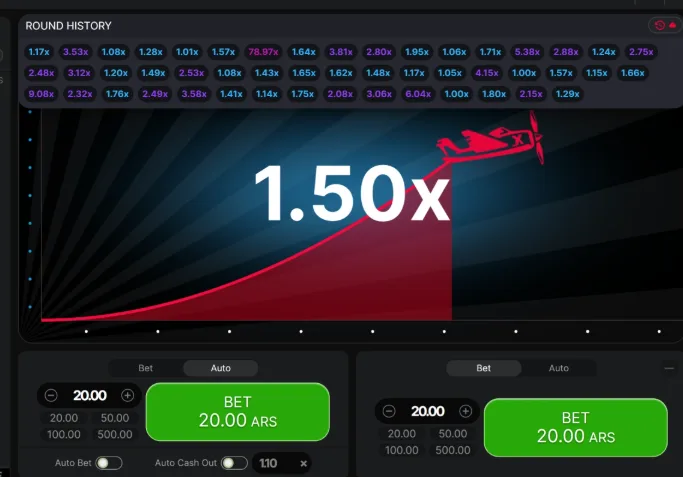
The genre was invented by the Georgian studio Spribe in 2019, with the release of Aviator. The game became so popular in India, Brazil, and the CIS that dozens of studios copied its mechanics.
How the result is calculated
Aviator's RTP is 97%, meaning that over the long run, the game returns 97 cents for every dollar wagered. This is significantly higher than the average for slots: the average in our database is 95.64%.
The multiplier at which the plane flies away is determined before the round starts, not at the moment you click. The "cash out" button has no effect other than whether you fix the result before the crash or not. The round is the same for everyone: thousands of players in one room see the same curve, they just exit it at different seconds.
Hence the bet feed on the side of the screen, where you can see who cashed out at what multiplier. It's real, but it's useless: someone else's successful cash out says nothing about the next round. Auto-cashout at a set multiplier also doesn't improve the math — it just presses the button for you so you don't get stuck.
Provably fair: why the result cannot be rigged
Here, crash games are fairer than slots, and this is their main argument.
Before the round, the server generates a secret number — the server seed — and publishes its SHA-256 hash. The hash is published in advance, and the number itself is hidden. Then client seeds are taken into account: they are provided by the players themselves, and anything can be put there, even a cat's name. The third element is the round counter.
The result is calculated from all three components simultaneously. The casino does not know the client seeds at the moment it fixes its hash. Players do not know the server seed until the round ends. Neither side can rig the result.
After the round, the server reveals the secret number, and anyone can recalculate the hash and compare it with what was published before the start. If it matches, then nothing was changed. In the game itself, there is a Provably Fair tab for this, where all three values and the final hash are located.
Why predictors and "signals" are a scam
A whole industry has grown around Aviator: predictor apps, paid Telegram channels with "signals," hacked versions of the game. None of them work, and here's why.
The result of the round is already determined at the moment it starts and is embedded in a number that no one but the server has until the crash itself. A predictor physically cannot read it — it has no way to get the server seed. Everything it shows on the screen is an animation, completely unrelated to the game.
There's also a simple common-sense check. A person who can predict the multiplier won't sell a subscription for a couple of thousand rubles. They'll just play themselves.
Separately about "hacked" APKs and mods: this is the worst option of all. The game in them is not real, but the application asks for access to notifications and files, and then SMS codes and card data are stolen. You can lose much more here than just your bet.
Aviator, Lucky Jet, JetX — what's the difference
There are many airplane games, and people constantly get confused.
Aviator is the original from Spribe, that red airplane. Lucky Jet is a clone from another studio, promoted by 1win, where instead of an airplane there's a character with a jetpack. JetX, Spaceman, Rocket are the same from third-party developers. The math is similar everywhere, only the design and RTP differ.
In our catalog, you'll find the original Aviator with a free demo. There are no clones: we connect entire studios, not individual games for specific casinos.
Mines and Plinko are structured similarly
Mines is a field with closed cells, some of which are mines. You open cells one by one, the multiplier grows, and you can cash out at any moment. The RTP is also 97%, and it uses the same provably fair system.
Plinko is where a ball falls down a pyramid and lands in a cell with a multiplier. You have no influence on the trajectory; the only choice is the risk level.
What all three have in common is transparent math and the ability to verify each round. This is precisely what attracted an audience that doesn't trust slots to the genre.
What to do about it
Try the demo before betting money: Aviator, Mines, and Plinko open directly on the game page, without registration.
And check that the casino even has a license — this can be done in a couple of seconds by domain. Crash games are often placed on platforms without documents, and the game's provably fair system won't save you there: the problem won't be with the round, but with withdrawals.