Stake Originals: Games, Payouts, and Fairness
Stake Originals are games that the platform developed itself, rather than acquiring them from studios like Pragmatic or NetEnt. There are over twenty-five of them, and it is these, not slots, that made Stake recognizable: Mines, Plinko, Limbo, Dice, and Crash are copied by dozens of platforms, but they originated here.
From a player's perspective, there is one crucial difference between Originals and a regular slot: the casino's commission size.
One Percent Versus Four
For all major Originals, the house edge is 1%, meaning a return of 99%. For an average online slot, it's around 96%, and for some, it's significantly lower. The difference seems small until you convert it into money.
| Turnover | Expected Loss at 1% | At 4% | Difference |
|---|---|---|---|
| $1000 | $10 | $40 | $30 |
| $10,000 | $100 | $400 | $300 |
| $100,000 | $1000 | $4000 | $3000 |
| $1,000,000 | $10,000 | $40,000 | $30,000 |
| $100,000,000 | $1,000,000 | $4,000,000 | $3,000,000 |
This doesn't mean that you win on Originals. It means that you lose four times slower on them. The difference between "losing one hundred dollars" and "losing four hundred" with the same turnover is significant, but both figures are negative.
Another side effect of a low house edge that is rarely considered: rakeback is calculated from it. Three and a half percent of one percent is 0.035% of turnover, while three and a half percent of four percent is 0.14%. This means that rakeback on slots is four times juicier precisely because the casino takes four times more.
Which Games Are Included
| Game | Mechanics | House edge |
|---|---|---|
| Mines | 5x5 field, open tiles and avoid hitting a mine | 1% |
| Plinko | ball falls through pegs into a cell with a multiplier | 1% |
| Limbo | name a multiplier and hope the round exceeds it | 1% |
| Dice | set a threshold and guess if the number will be higher or lower | 1% |
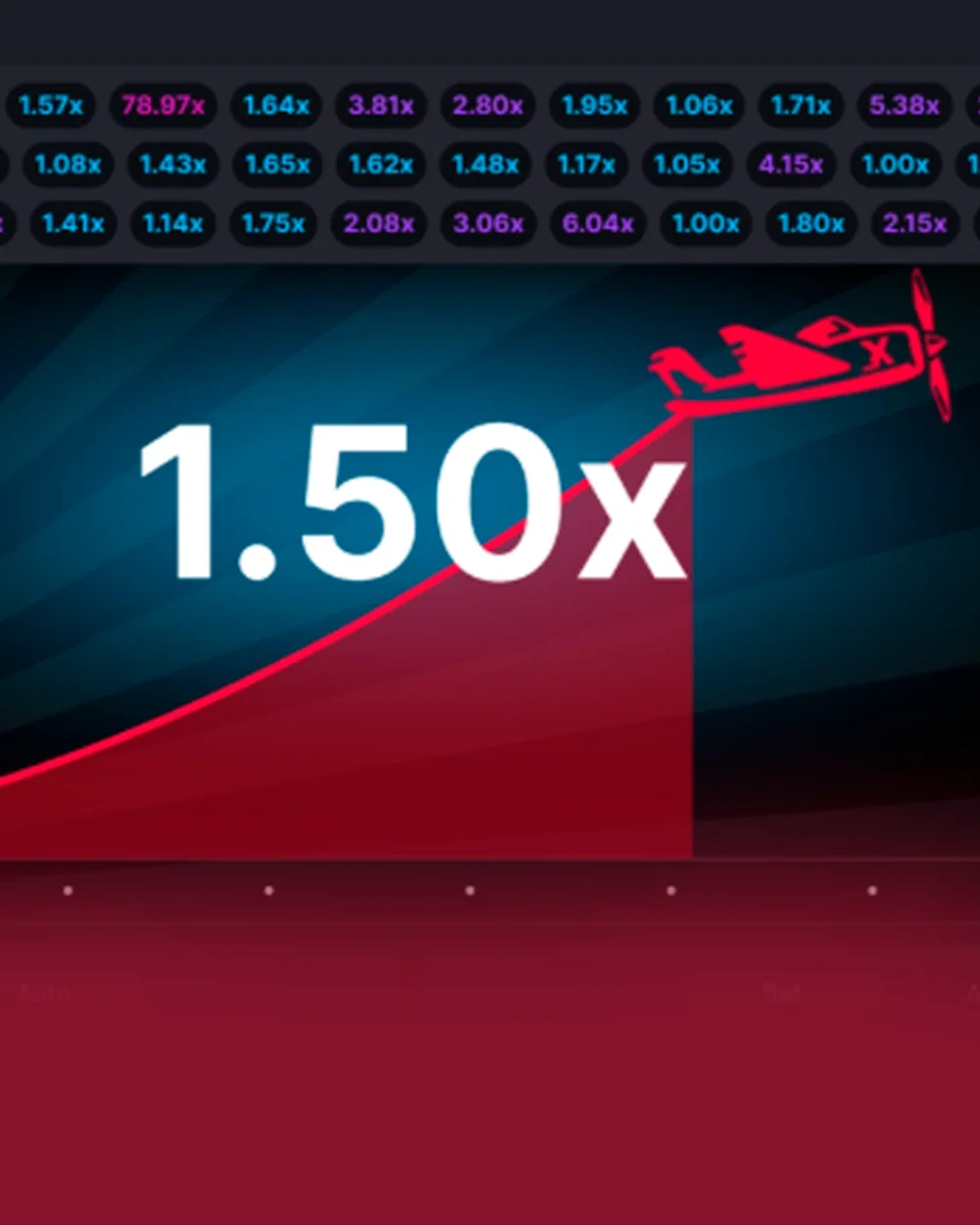
| Crash | cash out before the graph crashes | 1% |
| Keno | choose numbers on the field, matches give a multiplier | 1% |
| Hilo | guess if the next card is higher or lower | 1% |
| Wheel | wheel with customizable number of segments and risk | 1% |
| Dragon Tower | climb floors, choosing a safe door on each | 1% |
| Diamonds | a set of seven gems, matches pay | 1% |
In addition, there are card and table versions — blackjack, roulette, baccarat, video poker — where the return depends on the specific table rules and how correctly you play your hand, so it cannot be described by a single number. And several games that look like slots: Blue Samurai, Scarab Spin.
The mechanics of Limbo and Dice are identical, down to the design. In Limbo, you set a target multiplier, and the chance of winning is 99 divided by that multiplier: a 2x target gives 49.5%, a 10x target gives 9.9%, a 100x target gives 0.99%. In Dice, the same thing is expressed through a threshold: the payout is 99 divided by the winning percentage. The maximum multiplier in Limbo is one million, and by formula, this means a 0.000099% chance per round.
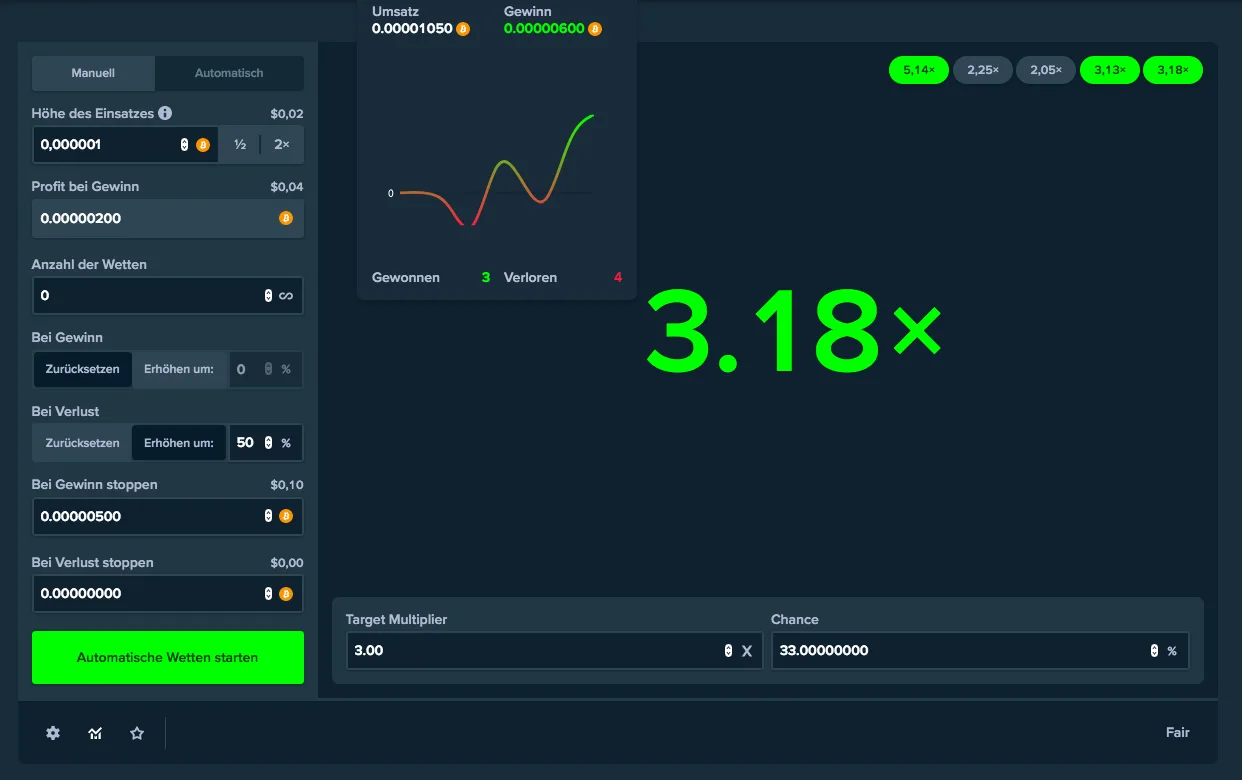
The formula is visible directly in the interface: in the Target Multiplier field, it says 3.00, and the game automatically sets the Chance to exactly 33% — that is, 99 divided by three.
Provably Fair: What It Actually Provides
Each round in Originals is assembled from three values:
Server Seed — a random string generated by Stake. You see its hash before the game starts, and you receive the string itself later.
Client Seed — a string on your side. You can change it at any time, and changing the seed reveals the previous server seed.
Nonce — the sequential number of a bet on the current seed pair. It increases by one with each round.
All of this is run through HMAC-SHA256, and the resulting hash is converted into the round's outcome — the arrangement of mines, the path of the ball, the crash point of the graph.
What follows from this. Since the server seed is fixed and you received its hash in advance, the casino cannot change the result after seeing your bet. If it wanted to, the hash wouldn't match, and it can be checked with one click by any third-party verifier.
And the reverse is also true, although it's mentioned less often. Until the server seed is revealed, no information about the result exists. It's not "difficult to calculate," it simply doesn't exist. Therefore, all "predictors" for Mines, Crash, and Plinko are either random image generators or a funnel to an affiliate link.
The check is done as follows: you change the client seed, take the revealed server seed, take the number of the desired bet, and run it through an open calculator. The result must match what you saw in the game.
Why fair math doesn't make the game profitable
It's worth pausing here, because confusion arises constantly.
Provably fair proves that the casino did not manipulate the outcome of a specific round. A 99% RTP means that over the long run, players get back 99 cents for every dollar wagered. Both facts are true, and both do not negate a third: one percent of the turnover goes to the casino, and as the number of rounds increases, this percentage is realized more accurately.
A thousand dollar bets means, on average, a ten-dollar loss, but the variance is such that you could also be up by a hundred. One hundred thousand bets — a thousand-dollar loss, and the probability of being in profit is already small. A million bets — a ten-thousand-dollar loss almost certainly. This is precisely why the casino is not afraid to show you the source code of its math: it works for them by design.
My experience
I played mostly Mines and Limbo on Stake, with turnover exceeding one hundred million dollars, and my status reached Diamond. The result — a big loss.
This is calculated exactly according to the table above: one hundred million at one percent is one million dollars in expected losses. Rakeback returned about thirty-five thousand. I hit X10,000 in Limbo many times, and they did not affect the overall result, because with such turnover, individual hits simply get lost in the statistics.
One percent is the best the market offers. It still proved sufficient.
Frequently Asked Questions
Is it true that Stake Originals have a 99% RTP? Yes, for the main games — Mines, Plinko, Limbo, Dice, Crash, Keno. We independently verified this on Plinko tables: the sum of all multipliers, weighted by probability, converges to 99%.
Can you play Originals for free? On stake.us — yes, there's in-game currency there. On stake.com, Originals do not have a demo mode.
Does the RTP change with settings? No. The number of mines in Mines, the risk in Plinko, the target multiplier in Limbo — all of this only changes the variance, but not the RTP.
How do Originals differ from slots on the same platform? Primarily by house edge: 1% versus approximately 4%. Plus provably fair — the result of a slot cannot be verified; there, the studio's license and audit are responsible for fairness.
Are there any working predictors? No, and they cannot exist: until the server seed is revealed, the result cannot be derived from anything.
The calculations on this page were performed by us and verified against Stake's stated game parameters. We do not place affiliate links and do not receive money for this material.