Plinko on Stake: Multipliers and Probabilities
A ball falls from the top onto a triangle of pegs, bouncing left or right on each row, and finally landing in one of the slots at the bottom. The slot determines the multiplier. There are only two settings: the number of rows, from eight to sixteen, and the risk level—low, medium, or high.
The game looks like pure chance, but the distribution here is calculated in a single line, and it immediately shows why high risk leads to ruin faster than it seems.
Where the ball actually lands
On each row, the ball goes left or right with equal chances. This means the probability of landing in slot number k with n rows is C(n, k) / 2ⁿ — a standard binomial distribution.
Practical meaning: the central slots collect almost all drops, while the extreme ones are rarely hit. With sixteen rows, the ball lands in the central slot in one out of five drops, and in the outermost slot once every 32,768 drops. This is not "rare"; it's approximately once every nine hours of continuous play at a rate of one drop per second.
This is precisely what all three risk levels are built upon. Multipliers at the edges increase, multipliers in the center decrease, but the total sum remains the same.
Multiplier tables
The board is symmetrical, so the tables show one half: position 0 is the central slot, then moving towards the edge. The "how often" column is the probability of landing in a slot at this position (for positions other than the center, both sides are accounted for at once).
8 rows
| Position from center | How often | Low | Medium | High |
|---|---|---|---|---|
| center | 27.34% | 0.5× | 0.4× | 0.2× |
| 1 | 43.75% | 1× | 0.7× | 0.3× |
| 2 | 21.88% | 1.1× | 1.3× | 1.5× |
| 3 | 6.25% | 2.1× | 3× | 4× |
| edge (4) | 0.781% | 5.6× | 13× | 29× |
12 rows
| Position from center | How often | Low | Medium | High |
|---|---|---|---|---|
| center | 22.56% | 0.5× | 0.3× | 0.2× |
| 1 | 38.67% | 1× | 0.6× | 0.2× |
| 2 | 24.17% | 1.1× | 1.1× | 0.7× |
| 3 | 10.74% | 1.4× | 2× | 2× |
| 4 | 3.22% | 1.6× | 4× | 8.1× |
| 5 | 0.586% | 3× | 11× | 24× |
| edge (6) | 0.049% | 10× | 33× | 170× |
16 rows
| Position from center | How often | Low | Medium | High |
|---|---|---|---|---|
| center | 19.64% | 0.5× | 0.3× | 0.2× |
| 1 | 34.91% | 1× | 0.5× | 0.2× |
| 2 | 24.44% | 1.1× | 1× | 0.2× |
| 3 | 13.33% | 1.2× | 1.5× | 2× |
| 4 | 5.55% | 1.4× | 3× | 4× |
| 5 | 1.71% | 1.4× | 5× | 9× |
| 6 | 0.366% | 2× | 10× | 26× |
| 7 | 0.049% | 9× | 41× | 130× |
| edge (8) | 0.0031% | 16× | 110× | 1000× |
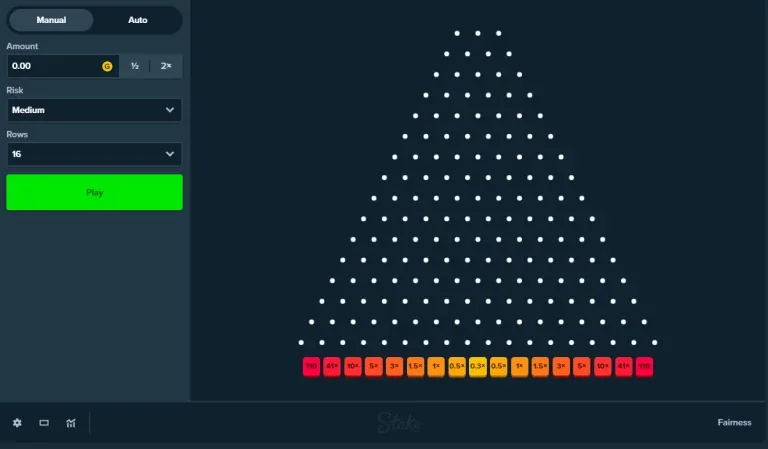
This is how it looks in the game itself: sixteen rows, medium risk. The row of slots at the bottom—110, 41, 10, 5, 3, 1.5, 1, 0.5, 0.3 and back again—matches the "Medium" column from the table above to the last digit.
How we verified these numbers
Multiplier tables circulate online in dozens of variations, and some of them are transcribed with errors. They can be verified without access to the game's code: if all multipliers, weighted by their probability of landing, are summed up, the return should be obtained.
The sum Σ C(n,k)/2ⁿ × multiplier for all nine configurations yielded between 98.91% and 99.12%—that is, exactly the 1% house edge that Stake claims. If there had been a typo in even one cell of the table, the sum would have deviated. So, the numbers above can be considered verified.
| Configuration | RTP | Drops of 1x and above | Max | How often max |
|---|---|---|---|---|
| 8 rows, low | 98.98% | 72.7% | 5.6x | 1 in 128 |
| 8 rows, medium | 98.91% | 28.9% | 13x | 1 in 128 |
| 8 rows, high | 99.06% | 28.9% | 29x | 1 in 128 |
| 12 rows, low | 98.98% | 77.4% | 10x | 1 in 2048 |
| 12 rows, medium | 98.99% | 38.8% | 33x | 1 in 2048 |
| 12 rows, high | 99.12% | 14.6% | 170x | 1 in 2048 |
| 16 rows, low | 99.00% | 80.4% | 16x | 1 in 32,768 |
| 16 rows, medium | 98.99% | 45.4% | 110x | 1 in 32,768 |
| 16 rows, high | 98.98% | 21.0% | 1000x | 1 in 32,768 |
What high risk actually means
Here's the main figure of the entire page. With sixteen rows at high risk, 79% of drops yield 0.2x — meaning they return a fifth of the bet. Another 13% give 2x, and only the remaining 8% are something serious.
The full distribution looks like this: 0.2x — 78.99%, 2x — 13.33%, 4x — 5.55%, 9x — 1.71%, 26x — 0.37%, 130x — 0.05%, 1000x — 0.003%.
A session of a hundred drops in this mode almost certainly looks like this: about eighty times you lose 80% of your bet, thirteen times you double up, and once or twice you get something significant. Your balance melts at the exact same rate as with low risk — the RTP is the same. The only difference is that with low risk, you lose slowly and steadily, while with high risk, you experience long periods of decline hoping for the edge of the board.
For comparison: with sixteen rows at low risk, eight out of ten drops yield at least a return of the bet. The feeling of the game is completely different, but the mathematical outcome is the same.
About strategies and autodrop
No setting changes the RTP — it's locked at 99% across all thirty-six combinations of rows and risk. All you control is the shape of the distribution.
This leads to what is usually sold as a strategy. Alternating risk is pointless: each drop has its own independent layout, and past results do not affect it. Chasing losses by doubling down on high risk is especially bad — with 79% of drops at 0.2x, a streak of ten consecutive failures is not uncommon, but rather normal, and by the tenth double-down, the bet increases 1024 times.
Autodrop with a thousand repetitions does not improve or worsen the chances. It only speeds up the process: a thousand drops with a 99% RTP on average leave 99.9% of the bankroll minus dispersion, and the higher the risk, the wider the spread around this average.
Fairness
Plinko operates on the same provably fair scheme as other Stake Originals. The path of the ball is determined by a hash of the server seed, client seed, and bet number. The server seed is fixed before the round, its hash is shown in advance, and after changing the client seed, it is fully revealed — and any past drop can be recalculated manually and verified.
This means that the casino cannot adjust the trajectory to the size of your bet. But it also means that it cannot be predicted: before the seed is revealed, information about the result does not exist in any form. Services promising to show where the next ball will land are showing random numbers.
Frequently Asked Questions
How many rows should I set? This does not affect the RTP. More rows — a stronger skew towards the center and rarer edges. Fewer rows — a more even distribution.
Is it true that 1000x actually drops? Yes, but the probability is 0.0031% per drop. On average, this is once every 32,768 drops, and there's no guarantee it will happen within the first hundred thousand.
Which configuration is the most profitable? None. All nine yield between 98.9% and 99.1%, the spread is within the rounding error of the multipliers.
Can I verify the drop? Yes. Change the client seed, get the revealed server seed, run it along with the bet number through HMAC-SHA256, and compare it with the trajectory.
Why is 0.2x so common on high risk? Because large multipliers at the edges need to be paid for somehow. For the total to remain 99%, the central cells have to be lowered almost to zero, and that's where the ball lands most often.
All probabilities and payout amounts on this page have been calculated by us from the binomial distribution and verified against the stated house edge. We do not place affiliate links.