Mines on Stake: Multipliers and Odds
A five-by-five field, twenty-five tiles. Before the round, you choose how many mines are hidden beneath them — from one to twenty-four. Then you open the tiles one by one: under each is either a diamond, and the multiplier grows, or a mine, and your bet is lost. You can collect your winnings after any click.
The entire game is based on a single formula, and it's worth dissecting it completely — everything else follows from it, including the answer to the question of whether there are working strategies.
Multiplier Formula
The multiplier after opening each tile is calculated as follows:
0.99 × C(25, d) / C(25 − m, d)
Here, m is the number of mines, d is how many diamonds have already been opened, and C(n, k) is the number of combinations, i.e., how many ways you can choose k tiles from n.
Let's break it down. C(25, d) represents all possible sets of tiles you could have opened on the field. C(25 − m, d) represents only those sets that do not contain any mines. The ratio of the first to the second is the fair coefficient: this is how much you should be paid for the game to break even in the long run. And 0.99 is that one percent that the casino keeps for itself.
Let's check with two extreme cases. Three mines, one diamond opened: 25 ÷ 22 = 1.136, multiplied by 0.99 — results in 1.12×. Twenty-four mines, one safe tile on the entire field: 25 ÷ 1 = 25, multiplied by 0.99 — 24.75×. Both numbers match what the game shows.
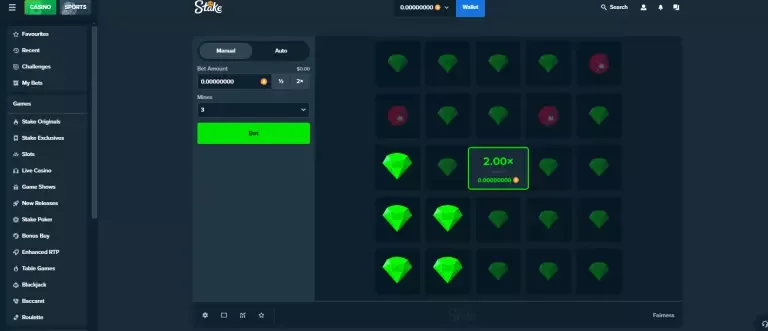
On the left side of the interface, you select the number of mines, and on the field, the multiplier that the next opened tile will give is highlighted. In the screenshot, three mines are set, and a value of 2.00× is shown — this is exactly the fifth row of the table below.
Payout Table
Full matrix: horizontally — how many mines are set, vertically — how many diamonds have already been opened. The values are calculated using the formula above, not copied from other screenshots.
The table is wider than the screen — scroll it sideways.
| GemsMines on the board | 1 | 2 | 3 | 4 | 5 | 6 | 7 | 8 | 9 | 10 | 11 | 12 | 13 | 14 | 15 | 16 | 17 | 18 | 19 | 20 | 21 | 22 | 23 | 24 |
|---|---|---|---|---|---|---|---|---|---|---|---|---|---|---|---|---|---|---|---|---|---|---|---|---|
| 1 | 1.03 | 1.08 | 1.13 | 1.18 | 1.24 | 1.30 | 1.38 | 1.46 | 1.55 | 1.65 | 1.77 | 1.90 | 2.06 | 2.25 | 2.48 | 2.75 | 3.09 | 3.54 | 4.13 | 4.95 | 6.19 | 8.25 | 12.38 | 24.75 |
| 2 | 1.08 | 1.17 | 1.29 | 1.41 | 1.56 | 1.74 | 1.94 | 2.18 | 2.48 | 2.83 | 3.26 | 3.81 | 4.50 | 5.40 | 6.60 | 8.25 | 10.61 | 14.14 | 19.80 | 29.70 | 49.50 | 99.00 | 297.00 | |
| 3 | 1.13 | 1.29 | 1.48 | 1.71 | 2.00 | 2.35 | 2.79 | 3.35 | 4.07 | 5.00 | 6.26 | 7.96 | 10.35 | 13.80 | 18.98 | 27.11 | 40.66 | 65.06 | 113.85 | 227.70 | 569.25 | 2,277 | ||
| 4 | 1.18 | 1.41 | 1.71 | 2.09 | 2.58 | 3.23 | 4.09 | 5.26 | 6.88 | 9.17 | 12.51 | 17.52 | 25.30 | 37.95 | 59.64 | 99.39 | 178.91 | 357.81 | 834.90 | 2,505 | 12,524 | |||
| 5 | 1.24 | 1.56 | 2.00 | 2.58 | 3.39 | 4.52 | 6.14 | 8.50 | 12.04 | 17.52 | 26.27 | 40.87 | 66.41 | 113.85 | 208.73 | 417.45 | 939.26 | 2,505 | 8,766 | 52,599 | ||||
| 6 | 1.30 | 1.74 | 2.35 | 3.23 | 4.52 | 6.46 | 9.44 | 14.17 | 21.89 | 35.03 | 58.38 | 102.17 | 189.75 | 379.50 | 834.90 | 2,087 | 6,262 | 25,047 | 175,329 | |||||
| 7 | 1.38 | 1.94 | 2.79 | 4.09 | 6.14 | 9.44 | 14.95 | 24.47 | 41.60 | 73.95 | 138.66 | 277.33 | 600.88 | 1,442 | 3,966 | 13,219 | 59,487 | 475,893 | ||||||
| 8 | 1.46 | 2.18 | 3.35 | 5.26 | 8.50 | 14.17 | 24.47 | 44.05 | 83.20 | 166.40 | 356.56 | 831.98 | 2,163 | 6,489 | 23,795 | 118,973 | 1,070,759 | |||||||
| 9 | 1.55 | 2.48 | 4.07 | 6.88 | 12.04 | 21.89 | 41.60 | 83.20 | 176.80 | 404.10 | 1,010 | 2,829 | 9,193 | 36,774 | 202,255 | 2,022,545 | ||||||||
| 10 | 1.65 | 2.83 | 5.00 | 9.17 | 17.52 | 35.03 | 73.95 | 166.40 | 404.10 | 1,078 | 3,233 | 11,315 | 49,031 | 294,188 | 3,236,072 | |||||||||
| 11 | 1.77 | 3.26 | 6.26 | 12.51 | 26.27 | 58.38 | 138.66 | 356.56 | 1,010 | 3,233 | 12,123 | 56,575 | 367,736 | 4,412,826 | ||||||||||
| 12 | 1.90 | 3.81 | 7.96 | 17.52 | 40.87 | 102.17 | 277.33 | 831.98 | 2,829 | 11,315 | 56,575 | 396,023 | 5,148,297 | |||||||||||
| 13 | 2.06 | 4.50 | 10.35 | 25.30 | 66.41 | 189.75 | 600.88 | 2,163 | 9,193 | 49,031 | 367,736 | 5,148,297 | ||||||||||||
| 14 | 2.25 | 5.40 | 13.80 | 37.95 | 113.85 | 379.50 | 1,442 | 6,489 | 36,774 | 294,188 | 4,412,826 | |||||||||||||
| 15 | 2.48 | 6.60 | 18.98 | 59.64 | 208.73 | 834.90 | 3,966 | 23,795 | 202,255 | 3,236,072 | ||||||||||||||
| 16 | 2.75 | 8.25 | 27.11 | 99.39 | 417.45 | 2,087 | 13,219 | 118,973 | 2,022,545 | |||||||||||||||
| 17 | 3.09 | 10.61 | 40.66 | 178.91 | 939.26 | 6,262 | 59,487 | 1,070,759 | ||||||||||||||||
| 18 | 3.54 | 14.14 | 65.06 | 357.81 | 2,505 | 25,047 | 475,893 | |||||||||||||||||
| 19 | 4.13 | 19.80 | 113.85 | 834.90 | 8,766 | 175,329 | ||||||||||||||||||
| 20 | 4.95 | 29.70 | 227.70 | 2,505 | 52,599 | |||||||||||||||||||
| 21 | 6.19 | 49.50 | 569.25 | 12,524 | ||||||||||||||||||||
| 22 | 8.25 | 99.00 | 2,277 | |||||||||||||||||||||
| 23 | 12.38 | 297.00 | ||||||||||||||||||||||
| 24 | 24.75 |
Note the symmetry: the multiplier for five mines and three diamonds is exactly the same as for three mines and five diamonds. This follows directly from the formula and serves as a quick check for any Mines table you come across: if the matrix is not symmetrical, it is calculated incorrectly.
The maximum in the table is 5,148,297× for thirteen mines and twelve opened diamonds. The value is exact: C(25,12) equals 5,200,300, there's nothing to divide by, so it remains to multiply by 0.99.
Rounding should be mentioned separately, because Mines tables online differ in the last digit. The game rounds, it doesn't truncate: three mines and five diamonds give exactly 1.99736, and 2.00× is shown on the screen. We calculate the same way.
The Odds Behind These Numbers
A payout table without a probability table is misleading — 3,236,072× looks tempting right up until you calculate how often it happens.
| Mines on field | 1 click | 3 clicks | 5 clicks | 10 clicks |
|---|---|---|---|---|
| 3 | 88.0% | 67.0% | 49.6% | 19.8% |
| 5 | 80.0% | 49.6% | 29.2% | 5.65% |
| 10 | 60.0% | 19.8% | 5.65% | 0.09% |
| 24 | 4.0% | — | — | — |
Five mines and five consecutive clicks — less than a third of rounds. Ten mines and five clicks — one round out of eighteen. And that multiplier of three million occurs with a probability of 0.00003%, which is approximately once every three million rounds.
Why the Number of Mines Changes Nothing
A common question: how many mines is it more profitable to play with. The answer is none, there is no difference at all.
The formula is designed so that 0.99 is a multiplier for everything else. No matter how many mines you set or how many clicks you make, the return remains exactly 99%. One mine and twenty-four mines only differ in the distribution shape: in the first case, many small wins and rare large losses, in the second, the opposite. The mathematical expectation is the same – minus one percent of the bet per round.
It also follows that auto-cashout at a certain multiplier doesn't improve anything. The variance changes, meaning how much the balance fluctuates, but not the long-term outcome.
About "Predictors" and "Patterns"
There are many search queries like "mines predictor" and "mines chart," and almost all of them yield the same set – websites and Telegram bots promising to show where the mines are. This cannot work due to the game's design, and here's why.
The layout of each round is derived from three values: server seed, client seed, and nonce – the sequential number of the bet. These are run through HMAC-SHA256, and the result is converted into the mine placement. Stake fixes the server seed before the round begins and immediately shows you its hash. It cannot be changed retroactively: the hash won't match, and this can be verified with one click.
Two things follow from this. The casino cannot manipulate the layout for your bet – it's determined before you click. And you cannot guess it: until the server seed is revealed, you don't have a single bit of information about where the mines are. No analysis of previous rounds helps here, because each round has its own nonce, and the hash function leaves no traces.
The practical conclusion is simple: any "predictor" either just draws random pictures or leads you to a platform via an affiliate link. The latter is more common.
What you can actually do is verify already played rounds. You change the client seed, the old server seed is revealed, and you run your rounds through any open verifier. If the layout matches what was in the game, the casino didn't cheat. This is the only working verification, and it's available on all provably fair platforms.
What "Strategies" Make Sense
No scheme changes the 99% return. But some things change how quickly you reach zero, and that's worth something too.
Martingale – doubling after a loss – works just as poorly in Mines as it does everywhere else. A streak of eight unsuccessful rounds with three clicks on five mines happens regularly, and the eighth doubling is already 256 initial bets. The table limit comes sooner than the return.
The only thing that truly affects the evening's outcome is the bet size relative to the bankroll and a pre-set stop. Not because it brings profit, but because it postpones the moment when the money runs out.
My Experience
Mines and Limbo are the two games where I've spent the most time on Stake. My turnover has exceeded one hundred million dollars, and in the end, I'm at a significant loss.
I've hit x10,000, and not just once. It feels like a turning point – that's it, everything's recovered. It hasn't. With a turnover of one hundred million and a casino margin of one percent, mathematics takes a million, and a few hits of ten thousand are simply invisible against that background. I'm not saying this for moral reasons, but because I thought differently myself and wish someone had shown me these numbers earlier.
Mines is more captivating than slots, and it's clear why: a round takes seconds, the "cash out" button is always at hand, and there's a complete feeling that the outcome depends on you. It doesn't. The tile was determined before your click.
Frequently Asked Questions
What number of mines is more profitable? None. The RTP is 99% in any case; only the variance changes.
Can I verify that the round was fair? Yes. Change the client seed, get the revealed server seed, and run the round through the verifier. The layout must match.
Are there any working predictors? No. The arrangement is determined by a hash of the seeds and the bet number; before the server seed is revealed, there is no information about it.
What is the maximum multiplier in Mines? The formula gives 3,236,072× — this is a full clear of the field with ten mines. The probability of such a round is about 0.00003%.
Does auto-cashout affect the payout? No. It only affects the variance.
All multipliers and probabilities on this page were calculated by us using the game's formula and verified against Stake's readings at control points. We do not place affiliate links.