Limbo on Duel: Multipliers up to 100,000x with No Casino Commission
On August 17, Duel introduced its twelfth game in the Originals lineup — Limbo. It added the simplest mechanic of all to the eleven games we previously reviewed: one number, one button, and a result in a second. The label is the same as the others — 100% RTP.
I've been playing it since day one and managed to hit the cap, 100,000x. More on that below, but first, let's talk about how the game works, because without the math, the story about the x doesn't explain anything.
How it works
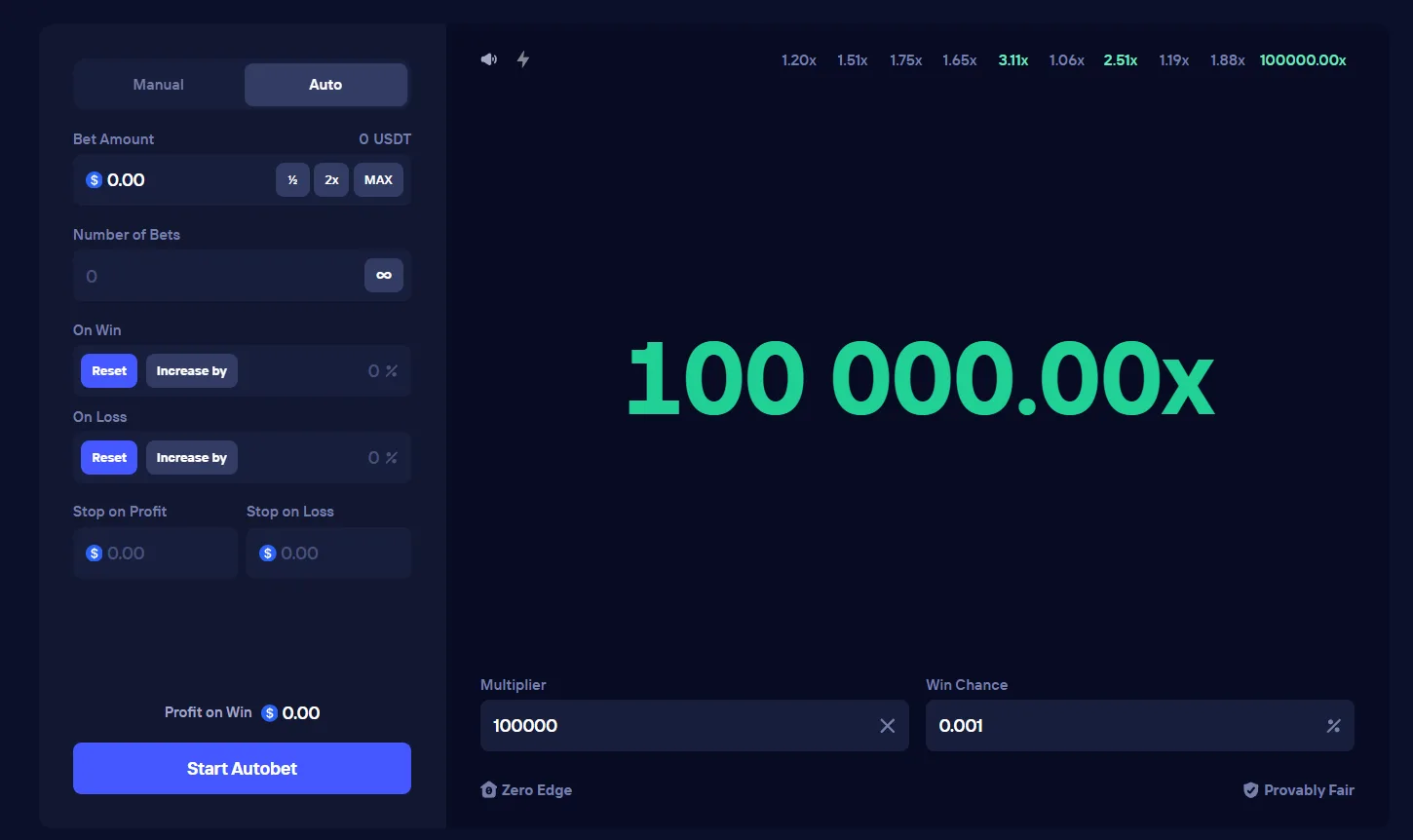
Before a round, you set two things: your bet and your target multiplier. Then the game throws a random number — what multiplier it reached this time. If it's not less than your target, your bet is multiplied by the target. If it's less, your bet is lost. That's it. No graph to follow, and no "cash out" button in the middle of the flight, like in Crash. The decision is made before the round; you can't change it during play. Essentially, it's Dice turned inside out: there you choose the chance, and the game shows the multiplier; here you choose the multiplier, and the game shows the chance.
 This chance is literally fair. With zero commission, the probability of winning is one divided by the multiplier: 2x appears in half of the rounds, 10x — in every tenth, 100x — once every hundred. The game displays this number directly in the settings as Win Chance, and you can check it in your head: one hundred divided by your multiplier.
| Multiplier | Chance per round | One hit per… |
|---|---|---|
| 1.5x | 66.67% | 1.5 rounds |
| 2x | 50% | 2 rounds |
| 5x | 20% | 5 rounds |
| 10x | 10% | 10 rounds |
| 100x | 1% | 100 rounds |
| 1,000x | 0.1% | 1,000 rounds |
| 10,000x | 0.01% | 10,000 rounds |
| 100,000x | 0.001% | 100,000 rounds |
Hence the one hundred percent: bet × multiplier × (1 / multiplier) = bet. The expected value of a round is zero for any target, whether 1.1x or 50,000x. For comparison: in Limbo on Stake, the chance is calculated as 0.99 / multiplier — that's the one percent commission, and at 2x, not half of the rounds win, but 49.5%.
Cap: 100,000x and $250,000
The maximum multiplier you can set is 100,000x. The maximum payout per round is $250,000. The second number is more important than the first. If your bet multiplied by your target is more than $250,000, you simply won't receive the excess. This means that for each multiplier, there's a bet above which it's pointless to go:
| Target | No point betting above this | Payout on hit |
|---|---|---|
| 100x | $1,000 (hits bet limit) | $100,000 |
| 250x | $1,000 | $250,000 |
| 1,000x | $250 | $250,000 |
| 10,000x | $25 | $250,000 |
| 100,000x | $2.50 | $250,000 |
So, hunting for 100,000x is a game of two and a half dollars, no more. Anyone betting ten dollars on such a multiplier gives away three-quarters of the potential winnings for nothing: the game will accept the bet but pay the same 250 thousand. The limit on a single bet is $1,000, and it cuts off the other end of the table: at 2x, you can't take more than two thousand per round.
Zero Edge with a limit
The Zero Edge window within the game shows something that is usually not found in the platform's promotional descriptions: the zero commission is not unlimited. There is a daily quota — $50,000 in turnover. As long as the total bets haven't reached this amount, the commission is zero. After that, 0.1% kicks in, meaning a 99.9% return, until the counter resets. The counter resets once a day; the timer until reset is visible in the same window.
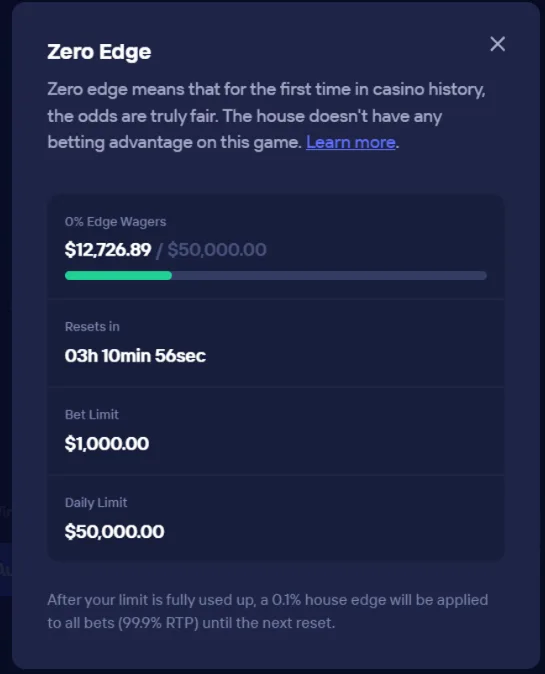 For most, this limit is theoretical: fifty thousand turnover per day is five thousand rounds at ten dollars. But autobet at medium stakes easily reaches the quota: two thousand rounds at $25, and you're over the line. After that, Limbo is still ten times cheaper than Stake in terms of commission, but no longer free.
And an important consequence: 100,000x doesn't get along with the quota. With a median of 69 thousand rounds until the first hit (more on that later), even at two and a half dollars, the turnover will exceed fifty thousand three times. My x, by the way, came already at 99.9%. This didn't noticeably affect the chance: the difference between 0.001% and 0.000999% exists only on paper.
For most, this limit is theoretical: fifty thousand turnover per day is five thousand rounds at ten dollars. But autobet at medium stakes easily reaches the quota: two thousand rounds at $25, and you're over the line. After that, Limbo is still ten times cheaper than Stake in terms of commission, but no longer free.
And an important consequence: 100,000x doesn't get along with the quota. With a median of 69 thousand rounds until the first hit (more on that later), even at two and a half dollars, the turnover will exceed fifty thousand three times. My x, by the way, came already at 99.9%. This didn't noticeably affect the chance: the difference between 0.001% and 0.000999% exists only on paper.
How rare is it really
A 0.001% chance per round doesn't say anything about how long to wait. You need to calculate differently: the probability of not hitting the target in k rounds is (1 − 1/N)^k. The median waiting time is approximately 0.69 × N: half of the players hit the target before this mark, half later.
| Target | Median rounds until first hit | Chance of not seeing target in "its" N rounds |
|---|---|---|
| 10x | 7 | 34.9% |
| 100x | 69 | 36.6% |
| 1,000x | 693 | 36.8% |
| 100,000x | 69,315 | 36.8% |
The last column is almost constant. You played exactly one hundred rounds at 100x — with a 36.6% probability, you still haven't seen a hundred. You played one hundred thousand at 100,000x — the same 36.8%. This is a property of any rare event, and it's the main reason why the feeling of "it should hit already" doesn't work in Limbo: the game doesn't remember the previous round, and after a thousand empty rounds at 1,000x, the chance of the next one is still the same 0.1%. I'll mention martingale at 2x in one line, because everyone tries it. Ten consecutive losses with a 50% chance happen once every 1,024 series. Doubling from one dollar, on the eleventh step, you'll hit the $1,000 bet limit, with a minus $1,023 on your balance. Zero commission doesn't save this scheme — it's not about commission at all.
How I hit 100,000x
I was betting a dollar on autobet with a target of 100,000x — more out of interest in the number itself than with any real expectation. What's unusual in Limbo compared to slots: the round result is always visible, even when you lose. The game reached 3,400x, you were aiming for one hundred thousand — zero, but the number is on the screen. For the first few hours, it's annoying. Then you get used to it and stop looking. It hit on the second day, in the evening. I won't give the exact number of rounds — I reset the autobet counter — but in terms of turnover, it was around one hundred thousand bets, which is roughly what the table above promises. On the screen: 100,000.00x, a green payout line, one hundred thousand dollars in the balance.
And then — the math that spoils the mood. If I had bet $2.50 instead of a dollar, the payout would have been $250,000. A dollar and a half difference per round, multiplied by one hundred thousand rounds, is 150 thousand in turnover, exactly what I lacked to hit the cap. In other words: I spent roughly as much on the way to the x as I received, and this is the most honest description of a 100% RTP game possible. It returned what was invested. It just returned it in one round, instead of spreading it over thousands. From this, one practical conclusion. If you're going for a big multiplier, first calculate the bet from the cap, not from your mood. Twenty-five dollars for 10,000x, two and a half for 100,000x. Anything above that is a gift to the platform.
What's in it for the player
Limbo is the most convenient place to see the 100% RTP claim with your own eyes. In Mines and Plinko, you have to calculate tables for this, which we did. Here, the chance is written next to the multiplier, and the match with 1/N is visible without a calculator.
Three things to keep in mind: The cap is $250,000. At high multipliers, it's more important than the bet limit. The table of maximum sensible bets is above — refer to it, not your balance. The daily Zero Edge quota. Fifty thousand turnover, then 0.1%. Unnoticeable for manual play, but for autobet, it's a matter of a couple of hours.
Variance hasn't gone anywhere. A zero expected value means that the average player breaks even. A specific player in a specific session — it's all about luck, and at 1,000x, "luck" stretches over hundreds of empty rounds in a row. Withdrawing a large sum after such a hit is a separate topic; we have a dedicated page for it. In short: limits and verification are spelled out in the rules, and it's better to read them before hitting, not after.
What to read next:
- Duel Originals: all games and their returns — a complete list and what stands behind the 100% RTP label
- Duel's Zero house edge — how the platform earns without commission
- Aviator and crash games: how it works — how Crash differs from Limbo and why you can't "catch the moment" there
- Withdrawing money from Duel — terms, limits, and what happens with large sums