Plinko on Duel: Multipliers and Actual Payout
Plinko at Duel looks exactly like everyone else's: a ball falls through a triangle of pegs, bounces left and right, and lands in a cell with a multiplier. The settings are the same — from eight to sixteen rows and three risk levels.
The difference is in one number at the bottom of the screen: the Zero Edge label instead of the usual house edge. We decided to check what's behind it and calculated the table manually.
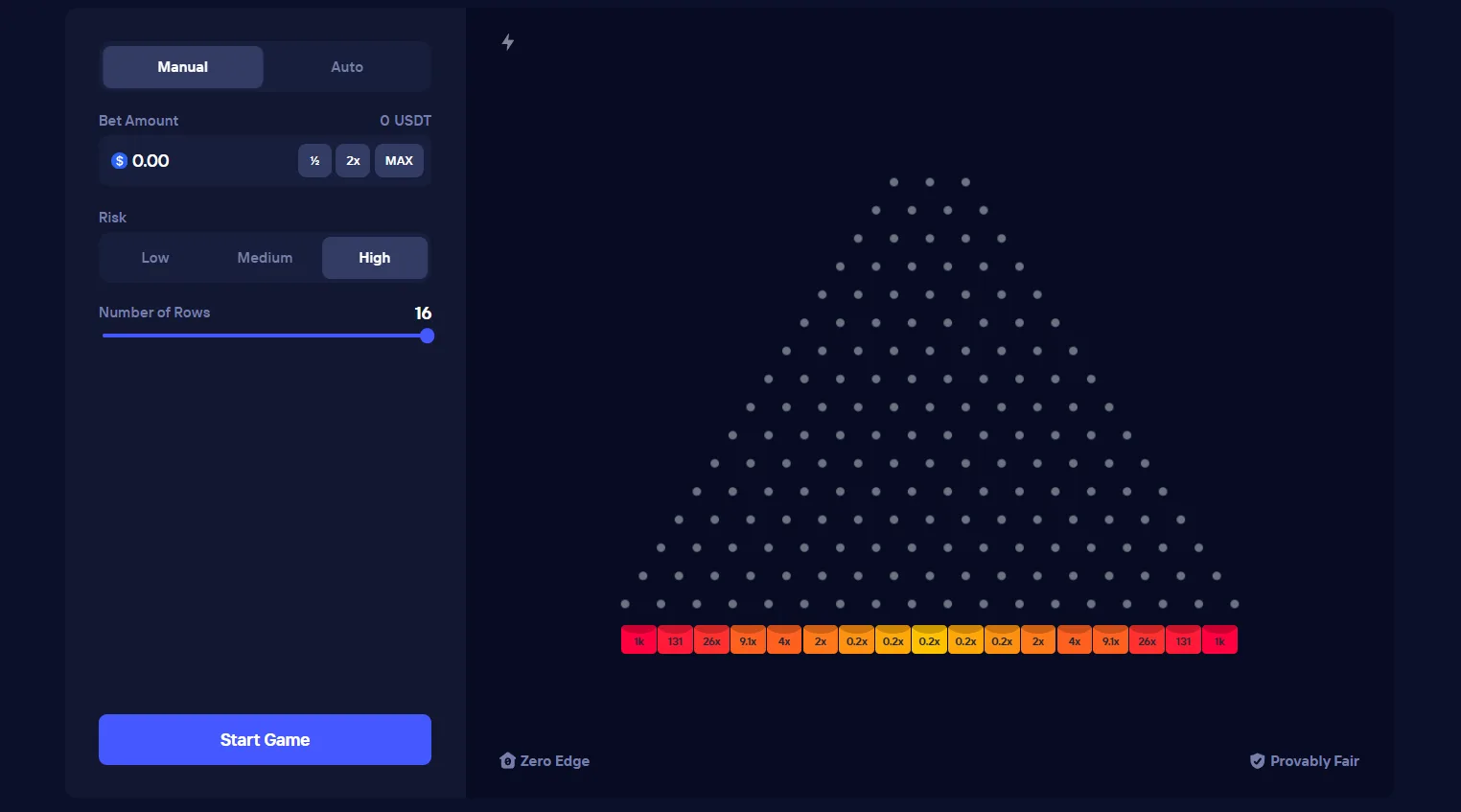
Their Table vs. Stake's Table
Sixteen rows, high risk. From left to right, from edge to center:
| Position from center | Frequency | Duel | Stake | Difference |
|---|---|---|---|---|
| center | 19.64% | 0.2× | 0.2× | — |
| 1 | 34.91% | 0.2× | 0.2× | — |
| 2 | 24.44% | 0.2× | 0.2× | — |
| 3 | 13.33% | 2× | 2× | — |
| 4 | 5.55% | 4× | 4× | — |
| 5 | 1.71% | 9.1× | 9× | +1.1% |
| 6 | 0.366% | 26× | 26× | — |
| 7 | 0.049% | 131× | 130× | +0.8% |
| edge (8) | 0.0031% | 1k | 1000× | ? |
The picture is clear: it's the same grid as Stake's, with the outer positions tweaked upwards. Nine became 9.1, one hundred thirty became one hundred thirty-one. This is exactly how the transition from 99% to 100% should look: the center cannot be touched because almost everything lands there, and at the edges, the increase costs almost nothing in terms of probability.
Calculating the Result
The payout of the Plinko table can be calculated without access to the code: sum all multipliers, weighting each by the probability of landing in its cell. The probability is binomial, C(16, k) / 2¹⁶.
For Stake's table, the sum gives 98.98% — exactly the stated one percent commission. For Duel's table, as it is drawn on the screen, the result is 99.196%.
Eight-tenths of a percentage point are missing to reach one hundred percent. Here's how their sum is composed:
| Position | Contribution to payout |
|---|---|
| edge (1k) | 3.05 p.p. |
| 131× | 6.40 p.p. |
| 26× | 9.52 p.p. |
| 9.1× | 15.55 p.p. |
| 4× | 22.22 p.p. |
| 2× | 26.66 p.p. |
| center (0.2×) | 15.80 p.p. |
| total | 99.20% |
What This Means
There is only one conclusion here, and it's not about deception. The label on the outermost cell is "1k", not a number. This is an abbreviation, and the actual value beneath it is greater than a thousand.
Let's calculate what it should be. For the sum to be exactly 100%, the edge must pay around 1263×. The outermost cell appears with a probability of 0.0031%, which is once every 32,768 drops, and that's why it can be loaded with the missing eight-tenths of a percent without changing anything else in the table.
So, what you see is not a discrepancy with the promise, but a rounding in the interface. But it's worth checking: if in your version of the game the edge truly pays exactly 1000×, the table's payout is 99.2%, not 100%. Hover your cursor over the outermost cell and check the exact value — it will take a second and resolve the question.
Why High Risk Is Still Tough
Zero commission doesn't make the distribution softer. With sixteen rows at high risk, 79% of drops yield 0.2×, meaning they return a fifth of the bet. This is a property of the table's form itself, not the casino's margin.
Breakdown by multipliers: 0.2× — 78.99% of drops, 2× — 13.33%, 4× — 5.55%, 9.1× — 1.71%, 26× — 0.37%, 131× — 0.05%, edge — 0.003%.
A session of one hundred drops almost certainly looks like this: about eighty times you lose 80% of your bet, thirteen times you double up, and once or twice you get something significant. With a zero expected value, the balance doesn't dwindle on average, but the variance around that average is huge, and going to zero over a hundred drops is common.
Low risk on the same sixteen rows gives a return of the bet or more in about eight out of ten drops. The feelings are completely different, the mathematical expectation is the same.
About strategies
No setting changes the payout: it is the same across all combinations of rows and risk. You only control the shape of the distribution.
Everything else follows from this. Alternating risk is pointless — each drop has its own independent layout. Chasing losses by doubling down on high risk is especially bad: with 79% of drops at 0.2×, a series of ten consecutive failures is not uncommon, and by the tenth doubling, the bet increases 1024 times. Autodrop for a thousand repetitions does not improve or worsen the chances, it only speeds up the process.
The only thing you actually influence is the bet size relative to your bankroll and the stopping point.
Fairness
Plinko on Duel operates on a provably fair scheme: the ball's path is determined by a hash of the server seed, your client seed, and the bet number. The server seed is fixed before the round, its hash is shown in advance, and after changing the client seed, it is fully revealed — and any past drop can be recalculated and verified.
This cuts off both extremes. The casino cannot adjust the trajectory to your bet size. And it cannot be predicted either: before the seed is revealed, no information about the result exists.
FAQ
Does Duel Plinko really have 100% RTP? By formula — yes, provided that the extreme cell pays about 1263×, and not exactly 1000×. The table drawn on the screen with a round thousand gives 99.196%.
How does their table differ from Stake? By two cells: 9 became 9.1, and 130 became 131. The center did not change.
How many rows to set? Does not affect the payout. More rows — stronger bias towards the center and rarer edges.
Why is 0.2× so frequent at high risk? Because large multipliers on the edges must be paid for by something, and they are paid for by the central cells, where the ball lands most often.
Can a specific drop be verified? Yes. Change the client seed, get the revealed server seed, and run it along with the bet number through HMAC-SHA256.
All probabilities and payout amounts are calculated by us from the binomial distribution according to the table from the screenshot above. We do not place affiliate links.